
FELICIA AMEZUGBE
Ghana
SURGICAL SITE INFECTIONS FOLLOWING COLORECTAL SURGERY, A STUDY AT THE KORLE BU TEACHING HOSPITAL, GHANA
Felicia Fafa Amezugbe
University of Ghana Medical School
Abstract
Background
Surgical site infections (SSI) following colorectal surgeries are of significant
concern due to their impact on patient outcomes including prolonged hospital stays and increased
healthcare costs (Zywot et al., 2017). Understanding the prevalence, risk factors, and clinical
outcomes of SSIs is essential for improving prevention strategies and patient care.
Methods
A retrospective study was conducted using medical records of 146 patients who
underwent colorectal surgeries at KBTH from January to December 2024. Data on patient
demographics, comorbidities, ASA classification, surgical type, wound classification, blood
transfusion, and postoperative outcomes were collected. Descriptive statistics were used to
summarize findings, and associations between risk factors and SSI occurrence were evaluated
using Chi-square tests, with significance set at p < 0.05.
Results
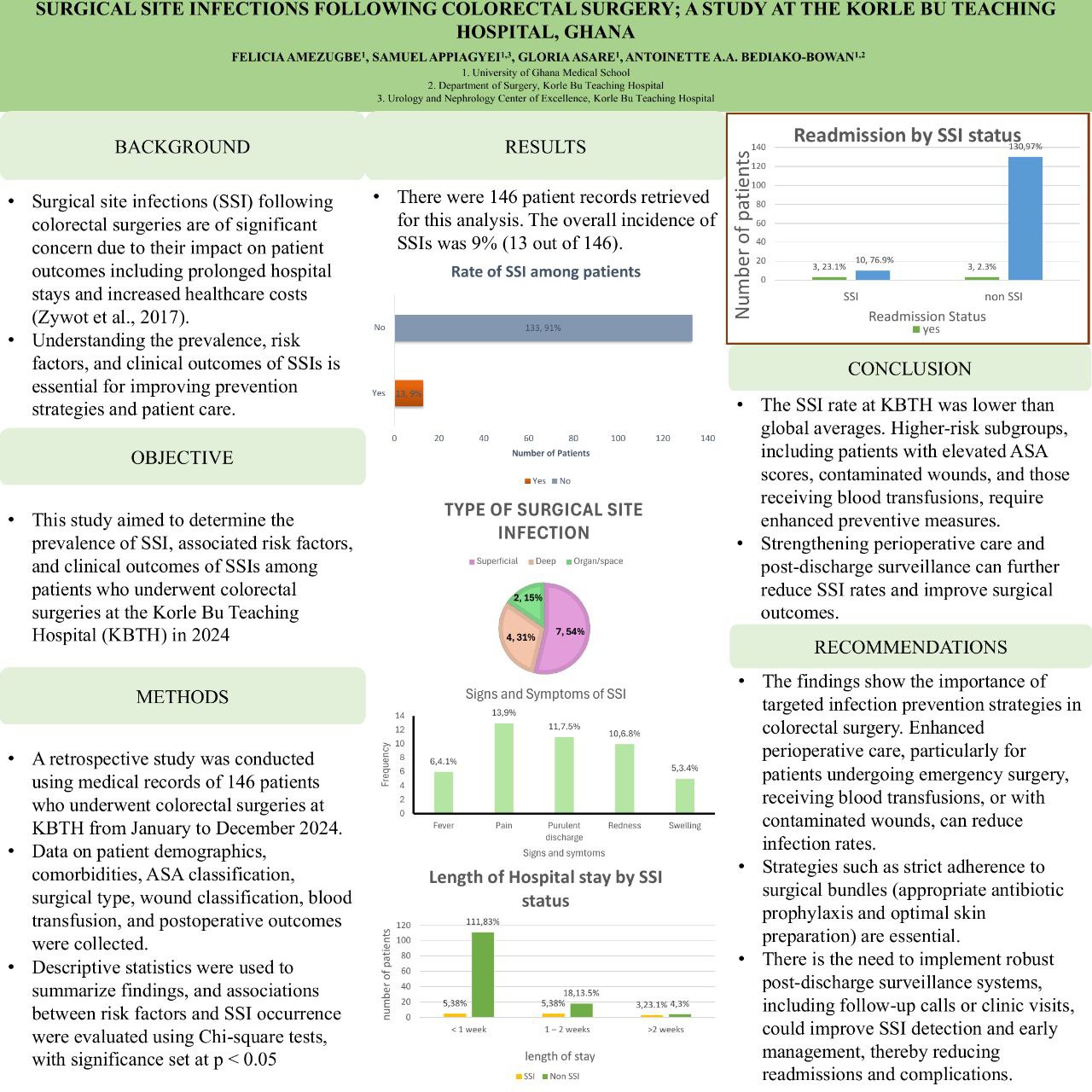
There were 146 patient records retrieved for this analysis. The overall incidence of SSIs
was 9% (13 out of 146). Superficial infections were the most common (54%/13), followed by deep
incisional (31%/13) and organ-space infections (15%/13). Emergency surgeries (12.5%, 6/146)
had a higher SSI rate compared to elective procedures (7.1%, 7/146). Patients with ASA Class II
(16.1%) showed increased infection rates compared to ASA Class I (6.9%), although this was not
statistically significant (p = 0.112). Blood transfusion was associated with a higher infection rate
(18.2%) compared to non-transfused patients (7.3%) (p = 0.097). The average length of stay of
patients with SSI was 7-14 days while those without SSI was less than 7 days.
Conclusions
The SSI rate at KBTH was lower than global averages. Higher-risk subgroups,
including patients with elevated ASA scores, contaminated wounds, and those receiving blood
transfusions, require enhanced preventive measures. Strengthening perioperative care and post-
discharge surveillance can further reduce SSI rates and improve surgical outcomes.
Leave A Comment